Introduction
Why is saffron so expensive? The answer is not simply that saffron is rare. Its price reflects a combination of biology, farming, hand harvesting, processing, quality control, transport, packaging and the very small amount of finished spice obtained from each flower. Understanding these factors helps shoppers compare saffron price per gram, 1 kg saffron price and Iranian saffron price without assuming that the cheapest product is the best value.
Saffron is made from the dried red stigmas of Crocus sativus. The Food and Agriculture Organization describes saffron harvesting as a time-sensitive process in which flowers are picked early and the stigmas are removed and dried on the same day. FAO also identifies Iran as the world’s leading saffron producer.
1. Saffron Comes From a Very Small Part of the Flower
Saffron is not made from the whole saffron flower. The culinary spice comes from its delicate red stigmas. This makes the usable portion of each flower extremely small compared with many other crops. Farmers therefore have to cultivate and process a large number of flowers to produce a relatively small quantity of finished spice.
2. Every Flower Produces Only a Few Threads
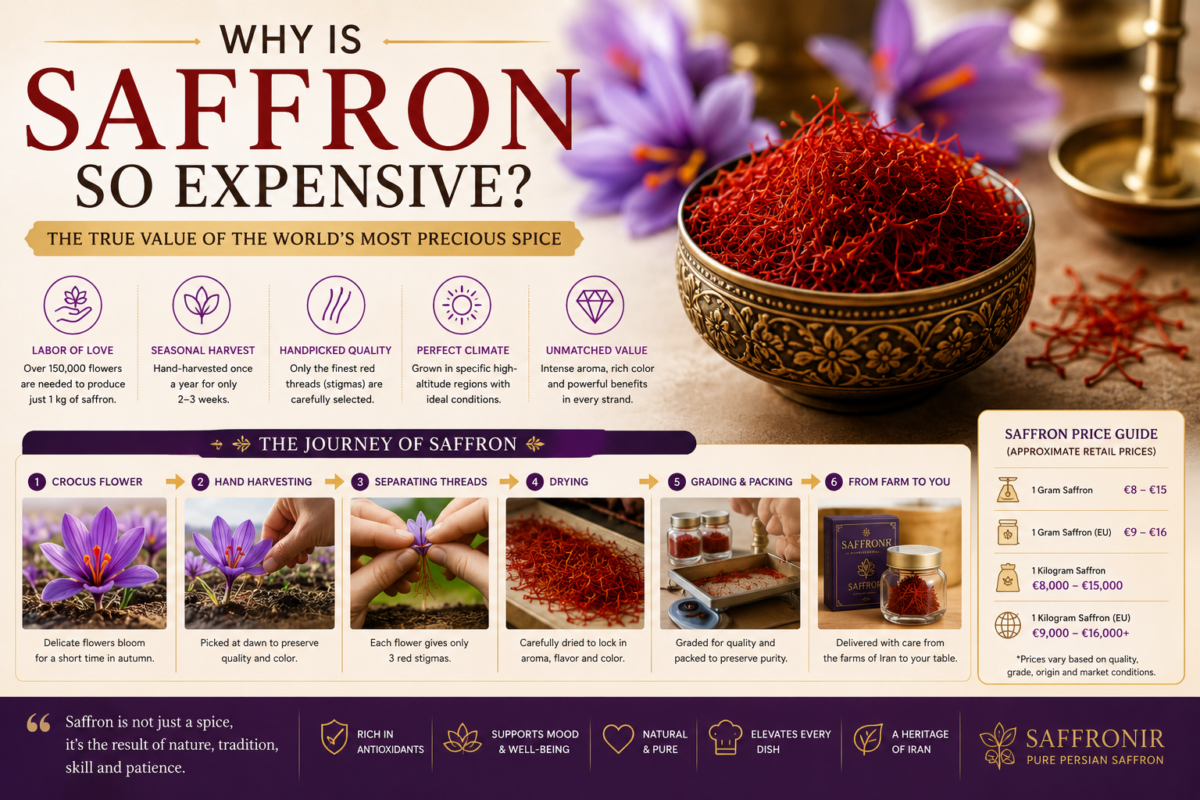
Each saffron flower produces only a few red stigmas. The Royal Horticultural Society notes that approximately 150 flowers are needed to produce 1 gram of dry saffron under its general growing guidance. That helps explain why even a small retail package represents substantial agricultural work and why the 1 gram saffron price can look high compared with ordinary spices.
3. Saffron Is Harvested by Hand
Saffron flowers are fragile and the valuable stigmas are tiny. Harvesting and separating them is traditionally done by hand, allowing workers to select the flowers and remove the desired threads carefully. Labour is therefore one of the largest components of saffron’s production cost.
4. The Harvesting Window Is Short
Saffron flowers do not bloom continuously throughout the year. The harvest takes place during a limited seasonal period, and individual flowers have a short useful flowering window. FAO describes the need for timely harvesting and same-day processing. This creates a concentrated period of intensive agricultural labour.
5. Drying and Processing Require Care
Fresh stigmas must be dried correctly before they become stable saffron. Too much moisture can affect storage, while excessive heat or poor handling can damage aroma and colour. After drying, saffron may be sorted, graded, inspected and packaged. Each step can add cost while protecting product quality.
If you want to buy Saffron , you can buy them here. : Saffron Shop
6. A Small Weight Represents a Large Harvest
FAO agricultural information gives an illustrative figure of about one million blooms per hectare producing around 10 kg of dried saffron under the cited conditions, although actual yields vary. The important point is that saffron is a high-value, low-volume crop. A kilogram represents an enormous amount of flowers and labour.
7. Iran Has a Major Saffron Tradition
Iran is central to the global saffron industry. FAO states that Iran is the world’s leading producer and documents saffron farming systems in Khorasan and other regions. This long production tradition supports specialist knowledge in cultivation, harvesting, drying and processing, helping explain why Iranian saffron is an important category for buyers.
8. Quality and Grade Affect the Price
Not all saffron has the same value. Price depends on thread quality, colour strength, aroma, cleanliness, freshness, grade, processing and packaging. A higher price can be justified when a product contains carefully selected whole threads and has reliable quality control. Two products with the same weight can therefore have very different value.
9. Understanding Negin and Sargol
Iranian saffron is often sold under terms such as Negin and Sargol. These names are associated with different thread characteristics and commercial grading conventions. Negin is generally associated with longer, fuller red threads, while Sargol refers to the red stigma portion without the yellow style. Exact classifications can vary by supplier, so buyers should read the product description rather than relying on the grade name alone.
10. Why Saffron Price Per Gram Looks High
Saffron is usually sold in very small quantities because only a little is needed for cooking. That makes the price per gram highly visible. A better comparison is cost per recipe or serving. A small quantity of good saffron can flavour and colour several dishes, so package price alone does not tell the whole value story.
11. Why the 1 Kg Saffron Price Is So High
The 1 kg saffron price reflects the accumulated cost of producing a huge quantity of flowers and processing the resulting stigmas. A kilogram can represent farming, harvesting, separation, drying, sorting, testing, packaging, storage, transport and commercial margins. There is therefore no single universal 1 kg saffron price; origin, grade, harvest, market and sales channel all matter.
12. Understanding Saffron Price in the EU
People searching for saffron EU price or 1 kg saffron price in EU should remember that European retail pricing includes more than the farm-level value. Importation, logistics, taxes, packaging, storage, compliance, payment processing and retail operations can all influence the final price. Comparing products is most useful when weight, origin, grade and packaging are equivalent.
13. Packaging and Retail Costs Matter
Saffron is sensitive to light, moisture and strong odours, so protective packaging is part of product quality. Retailers also have costs for warehousing, customer service, payment systems and delivery. A gift box may cost more than a basic pack because presentation is part of the product. The goal is to find a sensible balance between product quality, protection and price.
14. Why Extremely Cheap Saffron Can Be a Warning Sign
Saffron is expensive to produce, so a price far below comparable products deserves attention. It can reflect lower grade, old stock, poor handling, unusually low thread quality or adulteration. This does not mean the most expensive saffron is automatically the best. Buyers should compare origin, thread appearance, grade, packaging, freshness and supplier transparency.
15. Saffron Price Per Gram vs Gold
Saffron is sometimes called red gold, which leads to searches such as saffron price per gram vs gold. The comparison communicates saffron’s unusually high value by weight, but gold and saffron are completely different commodities with different markets and uses. The useful lesson is that saffron has an exceptionally high value-to-weight ratio for a culinary spice.
16. How to Compare Saffron Prices Fairly
Compare the same weight first. Then compare the same product type, origin and grade. Check whether the product is whole threads or powder, look at freshness and packaging, and consider the supplier’s transparency. Finally, compare the price per recipe rather than only the package price. This produces a much more meaningful comparison than simply choosing the lowest number.
17. Is Expensive Saffron Always Better?
No. Price is an indicator, not proof of quality. A premium product should provide reasons for its price, such as good raw material, careful grading, appropriate packaging, transparent sourcing and reliable quality control. A high price without useful product information does not automatically mean superior saffron.
18. How to Get Better Value When Buying Saffron
Buy a quantity that matches your cooking habits. Because saffron is used sparingly, a suitable premium pack can last for many recipes. Whole threads are useful when you want to inspect the product yourself. Store the saffron properly and prepare it correctly so you get maximum aroma and colour from every thread.
19. Store Saffron Properly
Keep saffron in a tightly sealed container in a cool, dry and dark place. Protect it from moisture, sunlight and strong kitchen smells. Good storage helps preserve the aroma and colour of the saffron you have paid for.
20. Frequently Asked Questions
Why is saffron so expensive? Because only a tiny part of each flower is used, harvesting is labour intensive, the flowering season is short, and drying and quality control require care.
What is the saffron price per kg? There is no single global price. The 1 kg saffron price varies by origin, grade, harvest, quality, market and sales channel.
What is the 1 gram saffron price? It depends on quality, origin, grade, packaging and retailer. Retail packs often have a higher per-gram price than wholesale quantities.
Why is Iranian saffron expensive? Iran has a major saffron-producing industry and a long production tradition. Grade, quality and processing determine the final Iranian saffron price per kg.
What affects saffron EU price? Import costs, logistics, taxes, packaging, quality, origin, grade and retail margins all contribute.
Is expensive saffron always better? No. Compare quality and transparency rather than price alone.
Conclusion
Saffron is expensive for a practical reason: producing a small amount requires a remarkable amount of agricultural work. From cultivation and flowering to hand harvesting, stigma separation, drying, grading, packaging and transport, every stage contributes to the final cost.
When you compare saffron price per gram, 1 kg saffron price or saffron EU price, do not focus only on the cheapest number. Compare origin, grade, weight, freshness, packaging and supplier transparency. Premium saffron is used sparingly, and when it is properly sourced and stored, a small quantity can bring remarkable colour and aroma to many dishes.