What Should You Check Before Buying Saffron?
Before looking at the price, start with the product itself.
A trustworthy saffron listing should give you enough information to understand what you are buying.
Look for:
- Country of origin
- Saffron type or grade
- Net weight
- Whole threads or powder
- Packaging information
- Storage recommendations
- Seller information
- Harvest or product information where available
The more transparent the product description is, the easier it is to compare products from different sellers.
1. Check the Country of Origin
One of the first questions to ask is:
Where does the saffron come from?
For shoppers interested in Persian cuisine, Iranian saffron is a natural choice. Iran has a long saffron-growing tradition, and Iranian saffron is widely used in Persian rice, chicken dishes, desserts, tea and other traditional recipes.
Spanish saffron is another established tradition, particularly from Castilla-La Mancha.
The important thing is not to assume that a country name alone determines quality. Origin tells you where the saffron comes from, but quality also depends on harvesting, processing, drying, storage and handling.
When shopping online, clear origin information is therefore an important starting point.
2. Choose Threads or Powder
Saffron is commonly sold in two main forms:
Whole Saffron Threads
Whole threads are usually the easiest option for shoppers who want to inspect their saffron before using it.
You can see the colour, shape and condition of the threads, and you can prepare exactly the amount needed for a recipe.
Whole saffron is especially useful for:
- Persian saffron rice
- Zereshk polo
- Chicken dishes
- Desserts
- Tea
- Special occasions and gifts
Saffron Powder
Saffron powder can be convenient because it is ready to use and easy to mix into food.
However, the appearance of the product is harder to inspect when it is already ground.
For buyers who want more visual transparency, whole saffron threads are often the simpler option.
3. Understand Saffron Grades
If you are comparing Iranian saffron, you may see names such as Sargol, Negin, Super Negin and Pushal.
These names describe different forms and selections of saffron.
Sargol mainly contains the red stigma tips and is a popular choice for everyday cooking.
Negin is known for longer, red saffron threads and is often used for premium culinary applications and presentation.
Super Negin generally refers to particularly long and carefully selected red threads.
Pushal includes red stigmas together with part of the yellow style.
There is no need to choose the most expensive type automatically. The right grade depends on how you plan to use the saffron.
For everyday cooking, Sargol can be a practical option. For premium presentation or gifting, Negin or Super Negin may be more suitable.
For a detailed explanation, read our guide:
Iranian Saffron: Grades, Quality & What Makes Persian Saffron Different
4. Look at the Colour and Appearance
Good-quality saffron threads should have a natural red to deep crimson appearance.
If a product contains a large amount of pale yellow material, understand what type of saffron you are buying before making a comparison.
Whole threads also make it easier to identify the physical form of the saffron.
Appearance is useful, but it should not be the only quality indicator. A beautiful-looking product can still vary in aroma, freshness and chemical characteristics.
That is why it is better to consider the complete product rather than judging saffron by colour alone.
5. Pay Attention to Aroma
Saffron has a distinctive aroma that is difficult to confuse with ordinary spices.
Fresh, properly stored saffron should have a characteristic floral, warm and slightly earthy fragrance.
Avoid products that smell strongly musty, stale or artificial.
Because saffron is used in small quantities, its aroma is an important part of the cooking experience.
6. Check the Packaging
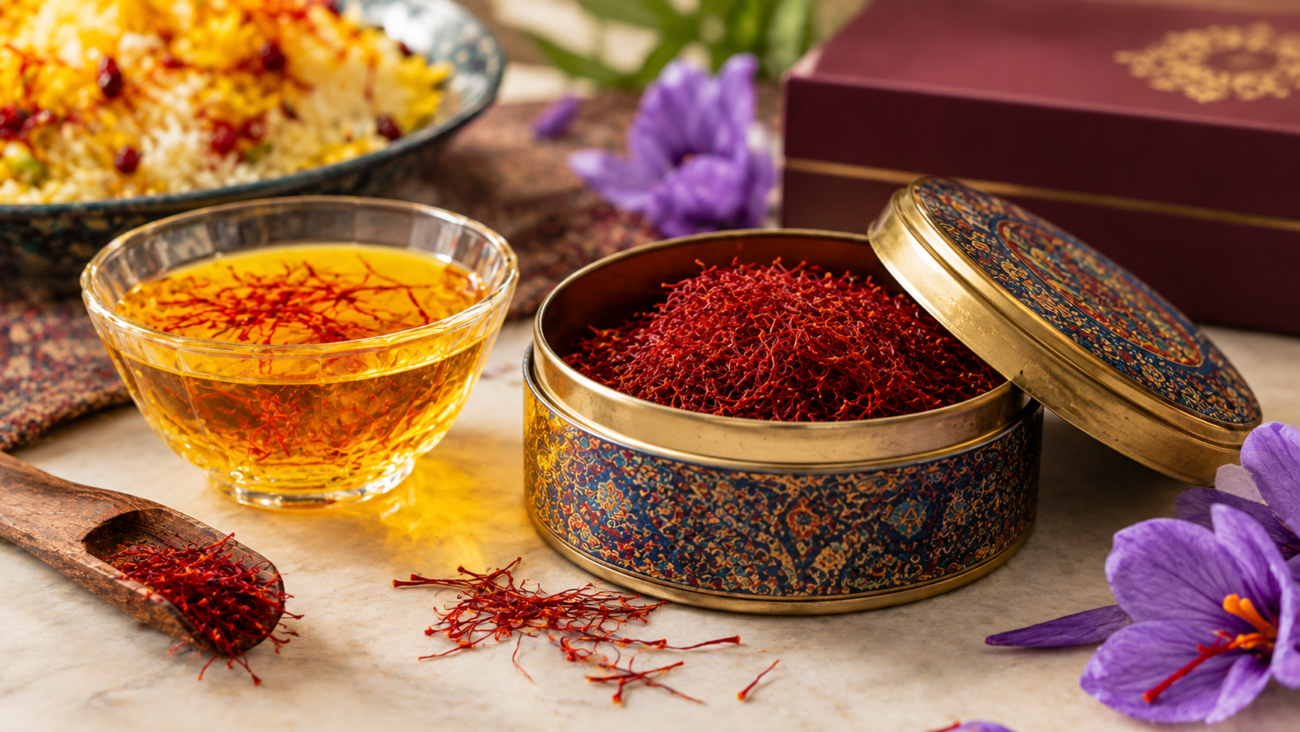
Saffron is a delicate spice and should be protected from environmental conditions that can affect its quality.
When buying saffron online, look for packaging that helps protect the product from:
- Moisture
- Excessive light
- Heat
- Air
Small, well-sealed packages can be particularly practical because they reduce the amount of saffron exposed to air each time the container is opened.
Once you receive your saffron, keep it tightly closed in a cool, dry and dark place.
7. Compare the Price per Gram
Saffron is expensive partly because harvesting and processing require significant manual work and a large number of flowers.
However, a higher price does not automatically mean higher quality.
When comparing products, calculate the price per gram rather than comparing package prices alone.
For example, a €50 package may seem more expensive than a €30 package, but the actual value depends on the weight and quality of the saffron.
Also compare like with like.
A large pack of premium Negin saffron should not be directly compared with a small package of a different grade.
8. Look for Quality Information
When available, product information or laboratory analysis can be useful when comparing saffron.
International saffron standards use measurable characteristics associated with colour, aroma and taste, including compounds known as crocin, safranal and picrocrocin.
This is one reason detailed product information can be more meaningful than marketing phrases such as “luxury” or “super premium”.
A transparent seller should explain what type of saffron is being offered rather than relying only on attractive wording.
9. Buying Iranian Saffron in Europe
For people searching specifically for Iranian saffron in the EU, there are several things worth checking.
Look for:
Clear origin: The product should clearly identify the country of origin rather than simply saying “premium saffron”.
Saffron type: Check whether it is Sargol, Negin, Super Negin, Pushal or another form.
Product weight: Compare the price per gram.
Packaging: Make sure the product is protected from moisture and light.
Seller transparency: Check who is selling the product and whether the product information is detailed and consistent.
For online shoppers, EU food-information rules also place requirements on food information supplied through distance selling. This makes clear product information especially important when buying food online.
10. Is Iranian Saffron a Good Choice for Persian Cooking?
Saffron is used in many cuisines around the world, but Iranian saffron has a particularly strong connection with Persian cuisine.
It is traditionally used in dishes such as:
- Saffron rice
- Zereshk polo
- Tahdig variations
- Chicken dishes
- Persian desserts
- Saffron tea
- Festive rice dishes
For anyone trying to recreate authentic Persian flavours, Iranian saffron is therefore a natural ingredient to consider.
You can learn how to prepare it properly in our article:
How to Use Saffron: A Complete Beginner’s Guide to Cooking, Tea & More
11. Buying Saffron Online for Gifts
Saffron is also popular as a food gift because a small quantity can be presented in elegant packaging and used for many different dishes.
When buying saffron as a gift, presentation becomes more important.
Premium thread grades such as Negin or Super Negin can work particularly well for gift products because the long red threads create a striking appearance.
A Persian saffron gift can also be combined with other traditional ingredients or Persian-inspired products.
Explore our Persian saffron gift boxes and gift packs when you are looking for a culinary gift with a Persian connection.
12. How Much Saffron Should You Buy?
The right quantity depends on how often you cook with saffron.
For occasional home cooking, a small package may be enough.
For people who regularly prepare Persian rice, desserts or tea, a larger package can offer better value.
Restaurants, caterers and frequent saffron users may naturally need much larger quantities.
Rather than buying the largest package available, choose an amount that you can store properly and use while the saffron remains in good condition.
What Is the Best Saffron in Europe?
There is no single saffron that is the right choice for every person.
Instead of searching only for the “best saffron in Europe,” consider what matters for your particular use.
For Persian cuisine, you may want authentic Iranian saffron.
For premium presentation, you may prefer long Negin or Super Negin threads.
For everyday cooking, Sargol can be a practical option.
For convenience, powder may suit you better.
The best purchase is therefore the one that combines clear origin, suitable grade, good packaging, transparent information and a price that makes sense for your needs.
Iranian Saffron at Saffronir
Saffronir focuses on Persian saffron and traditional Persian foods, with different saffron formats available for everyday cooking, larger quantities and gifting.
The current range includes normal saffron packages, metal packs, saffron powder and gift-pack options.
This allows shoppers to choose based on both quantity and intended use rather than buying the same format for every occasion.
Explore the Saffronir saffron collection to compare the available products.