What Is Real Saffron?
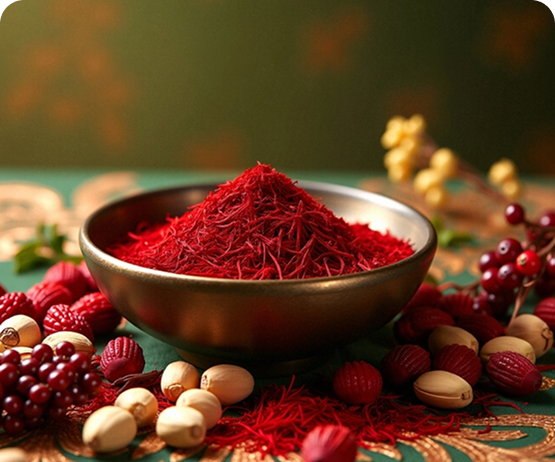
Real saffron comes from the dried stigmas of the Crocus sativus flower.
The flowers have delicate purple petals and produce three red stigmas. These stigmas are separated from the flowers and carefully dried before becoming the saffron threads used in cooking.
The current ISO 3632-1:2025 standard applies to dried saffron obtained from Crocus sativus and covers saffron sold as filaments, cut filaments and powder.
This is important because “real saffron” and “high-quality saffron” are not exactly the same thing.
A saffron product can be genuine but old, poorly stored or lower in quality. On the other hand, a product can look attractive while containing unwanted plant material or colouring.
So the goal is to consider authenticity and quality separately.
How to Tell If Saffron Is Real
There is no magic test that gives a 100% answer at home.
Instead, use several simple checks together.
1. Look Closely at the Saffron Threads
This is one of the easiest places to start.
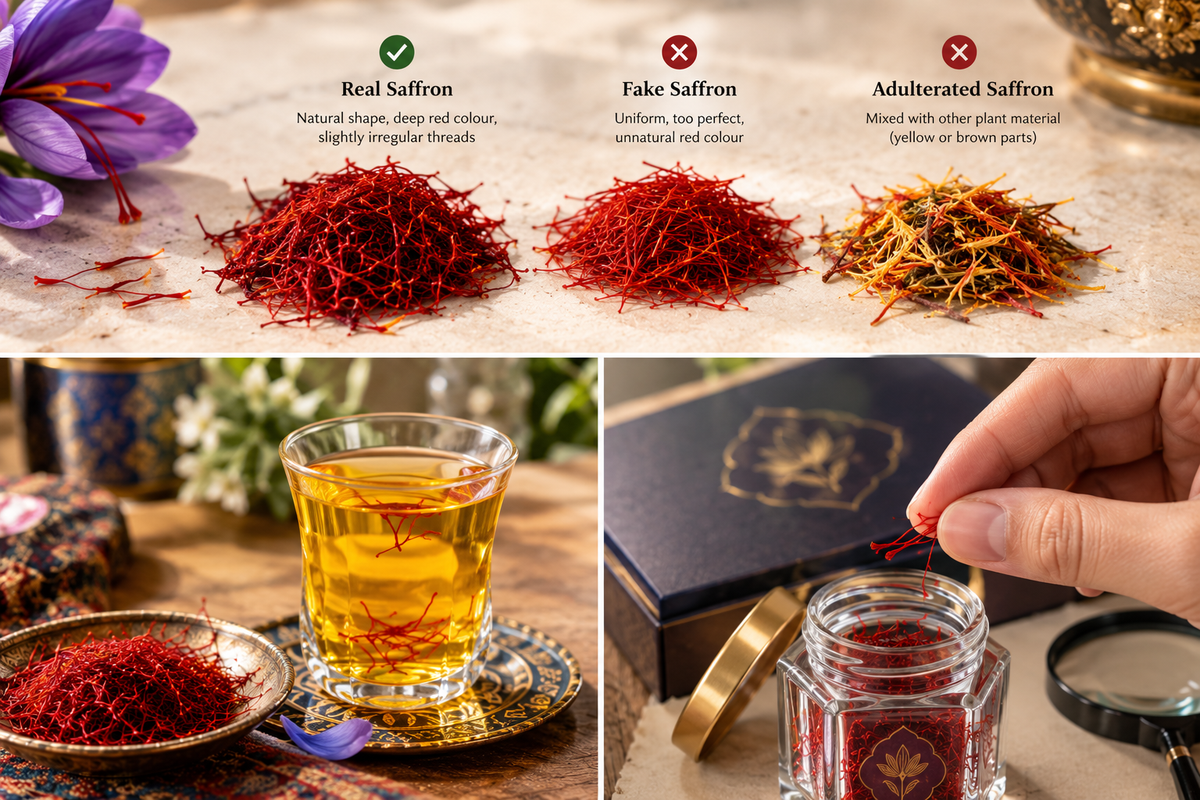
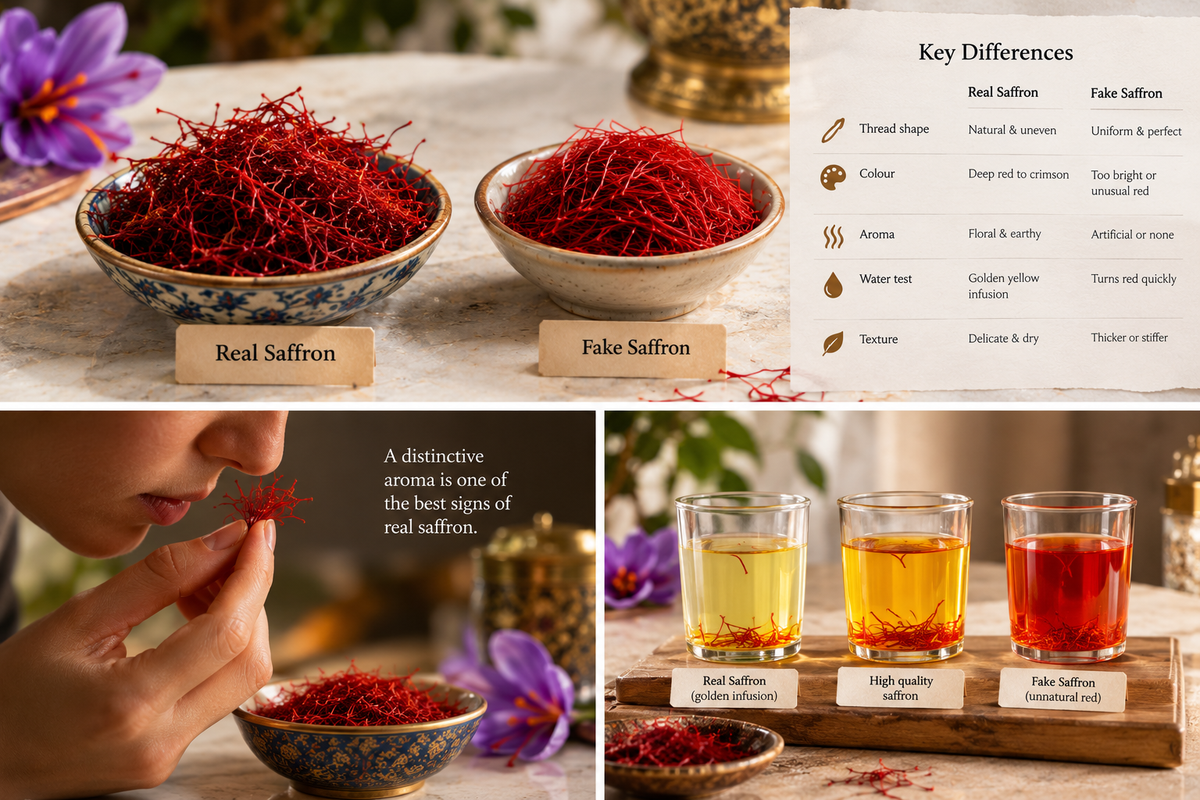
Whole saffron threads should look like natural parts of a flower rather than perfectly uniform red fibres.
Individual threads can vary slightly in length and shape. The stigma typically has a somewhat wider, trumpet-like end.
Be cautious if the material looks unnaturally uniform, resembles simple red fibres or contains a large amount of material that does not resemble saffron.
This is one reason whole threads are often easier to inspect than powder.
What Real Saffron Usually Looks Like
Genuine saffron threads are generally:
- Deep red to crimson
- Naturally uneven
- Delicate and dry
- Clearly identifiable as flower stigmas
- Free from obvious artificial colouring or unrelated plant material
Appearance alone cannot certify authenticity, but it can help you notice obvious problems.
2. Check the Aroma
Real saffron has a distinctive aroma.
Depending on the saffron and its freshness, people may describe it as floral, earthy, warm, dry or slightly hay-like.
The smell should not strongly resemble artificial perfume or a chemical fragrance.
However, aroma also changes with storage and age.
This means a weak-smelling saffron product is not automatically fake. It may simply have lost some of its aroma over time.
Use smell as one clue, rather than as a final verdict.
3. Try the Water Test Carefully
The famous saffron water test can be useful as a basic screening method, but it is often exaggerated online.
Place a few saffron threads into a small glass of water and observe what happens.
Genuine saffron normally releases its natural colour gradually, producing a yellow-to-golden infusion while the threads remain visible.
A suspicious product may release an unusually intense red colour almost immediately, particularly if artificial colouring is present.
But remember:
A water test cannot prove that saffron is genuine.
Different saffron products can release colour at different speeds depending on their condition, form and preparation.
Think of this test as a way to identify a possible warning sign—not as a laboratory test.
4. Do Not Trust the “Red Water Means Real” Myth
This is one of the most common mistakes when people search for information about fake saffron.
People sometimes say:
“If the water turns red, the saffron is real.”
That is not a reliable rule.
The naturally occurring compounds responsible for saffron’s colour behave differently from simple artificial dyes, but a home water test cannot identify every form of adulteration.
Likewise, weak colour does not automatically mean the saffron is fake.
The important question is not simply:
“Did the water change colour?”
It is:
“What does the complete combination of appearance, aroma, product information and quality evidence tell me?”
5. Check the Saffron After Soaking
Look at the threads again after they have been in water.
The threads should remain recognisable rather than immediately dissolving or behaving like dyed paper or another artificial material.
The water should develop a natural golden-yellow colour rather than simply becoming a dramatic artificial-looking red.
Again, this is only a screening method.
An authentic saffron product can still vary in colour release depending on its grade and condition.
6. Be Careful With the Rub Test
Another popular internet method is rubbing saffron between damp fingers or on wet paper.
The idea is that genuine saffron should not immediately produce an intense artificial-looking red stain.
This can sometimes reveal an obvious dye, but it should not be treated as proof of authenticity.
A determined adulterated product can behave differently under different conditions, and genuine saffron can also leave colour.
So use this test only as an additional observation.
7. Consider the Taste—But Don’t Taste Unknown Products
Saffron has a distinctive flavour that is generally aromatic and slightly bitter rather than simply sweet.
However, tasting is not a good first-line authenticity test, especially for a product from an unknown source.
Do not taste saffron that appears contaminated, mouldy, unusually wet or otherwise unsafe.
For a product you know is a food-grade spice, taste can be an additional sensory clue, but it cannot establish purity.
What Is Fake Saffron Made From?
Saffron’s high value makes it vulnerable to economically motivated adulteration.
The U.S. Food and Drug Administration gives an example of spice fraud involving expensive saffron being bulked with other plant material, such as plant stems.
Other look-alike materials discussed in saffron research and industry literature include various coloured plant fibres or other plant parts.
The key issue for consumers is simple:
Something that looks like saffron is not necessarily saffron.
That is why whole threads, transparent product information and a trustworthy seller can make purchasing easier.
Real Saffron vs Fake Saffron: What to Look For
| Check | Genuine saffron may show | Warning sign |
|---|---|---|
| Thread shape | Natural, stigma-like form | Uniform artificial-looking fibres |
| Colour | Natural deep red/crimson threads | Suspiciously uniform colouring |
| Aroma | Distinctive floral, earthy aroma | Strong artificial or chemical smell |
| Water | Gradual golden colour release | Extremely fast, unnatural red colouring |
| Threads after soaking | Threads remain recognisable | Material quickly loses its appearance |
| Packaging | Clear product information | Little or no origin information |
| Seller | Traceable and transparent | Unclear source or exaggerated claims |
| Laboratory evidence | Meaningful quality information | No supporting evidence for strong claims |
The table should be used as a checklist, not as a substitute for laboratory analysis.
Is Expensive Saffron Always Real?
No.
Price can provide useful context, but it is not proof of authenticity.
An unusually cheap product may deserve closer attention because saffron requires considerable labour to harvest and process. But an expensive product can also be poorly stored, misrepresented or simply overpriced.
Instead of asking:
“Is this saffron expensive enough to be real?”
ask:
“Does the price make sense for the origin, grade, quantity, packaging and available quality information?”
This is a much better way to compare products.
Does Saffron Grade Prove That It Is Genuine?
No.
Names such as Sargol, Negin and Super Negin describe traditional types or selections of saffron, but a grade name by itself should not be treated as laboratory proof of purity.
For example, Negin is associated with longer red threads, while Sargol mainly contains the red stigma tips.
We explained these differences in our previous article:
Iranian Saffron: Grades, Quality & What Makes Persian Saffron Different
The most useful approach is to consider grade + physical appearance + seller information + quality evidence.
Why Saffron Threads Are Easier to Inspect Than Powder
Saffron powder can be extremely convenient in the kitchen.
However, once saffron is ground, it becomes much more difficult for a consumer to inspect the original thread structure.
Whole threads allow you to look at:
- Shape
- Length
- Colour
- Visible plant material
- General condition
This does not mean saffron powder is automatically fake or lower quality.
It simply means that whole threads provide greater visual transparency.
For buyers who are learning how to identify genuine saffron, threads can therefore be a practical choice.
How to Choose Authentic Saffron Online
Buying saffron online requires a slightly different approach because you cannot physically inspect the product before placing your order.
You can buy your saffron online here : Saffron
Clear Origin
The seller should clearly state where the saffron comes from.
For Persian saffron, look for a clearly identified Iranian origin rather than vague terms such as “international saffron”.
Identified Type or Grade
The listing should explain whether the saffron is Sargol, Negin, Super Negin or another form where relevant.
Exact Weight
Always check the net weight.
Comparing a €30 package with a €60 package is meaningless until you know how many grams each contains.
Suitable Packaging
Saffron should be protected from moisture and excessive exposure to light and air.
Good packaging helps preserve the product during storage and transport.
Reliable Seller Information
Look for a business with clear contact information, product descriptions and purchasing policies.
The more transparent the seller is, the easier it is to make an informed decision.
Can Laboratory Testing Prove Saffron Quality?
Laboratory testing is much more reliable than a home experiment when you need objective evidence about saffron quality.
The ISO 3632 standard provides specifications for dried saffron and covers products in filament, cut-filament and powder forms.
Professional analysis can evaluate measurable characteristics associated with saffron’s colour, aroma and taste.
This is particularly useful for commercial buyers, restaurants, importers and sellers dealing with larger quantities.
For normal home cooking, you may not need a laboratory certificate for every small purchase. But when a seller makes strong quality claims, meaningful batch or testing information can provide more confidence.
How Saffronir Makes Saffron Easier to Inspect
One useful feature of some Saffronir saffron products is the use of packaging designed to let customers see the threads.
For example, the Saffronir 4.6 g Sargol normal package includes a display window so the saffron can be visually inspected inside the package.
This is helpful because consumers can see the product rather than relying entirely on a photograph or marketing description.
Saffronir also offers different saffron formats, including normal packages, metal packs, gift packs and saffron powder.
How to Store Real Saffron
Even genuine saffron can lose quality if it is stored badly.
After buying saffron, keep it:
- Tightly sealed
- Away from moisture
- Away from direct sunlight
- Away from excessive heat
- Away from strong kitchen odours
A cool, dry and dark cupboard is usually a practical place for home storage.
Correct storage helps preserve the saffron’s aroma, colour and flavour.
What About “Organic” Saffron?
The word “organic” should not be used as a shortcut for authenticity.
Organic certification and saffron authenticity are different questions.
A buyer should still check the origin, product information, certification where claimed and the seller’s transparency.
Likewise, words such as:
Premium
Luxury
Pure
Extra quality
should not replace meaningful information about the actual product.
7 Things to Remember Before Buying Saffron
When you are trying to identify real saffron, remember these seven principles:
1. Look at the threads. Natural saffron has a recognisable flower-stigma form.
2. Smell it. Genuine saffron has a distinctive natural aroma.
3. Observe the water test. Use it as a warning-sign check, not proof.
4. Check the packaging. Good packaging protects a delicate spice.
5. Verify the origin. Know where your saffron comes from.
6. Compare the grade and weight. Do not compare products only by package price.
7. Look for credible quality information. Laboratory evidence is much stronger than a single home test.